Here is The Hart Habits framework I built and have used to help hundreds of people navigate their relationships, both personal and professional.
Since you've made it this far, it's time for you to see the easy framework I built to help you apply these principles every day, any time, with a moment's thought.
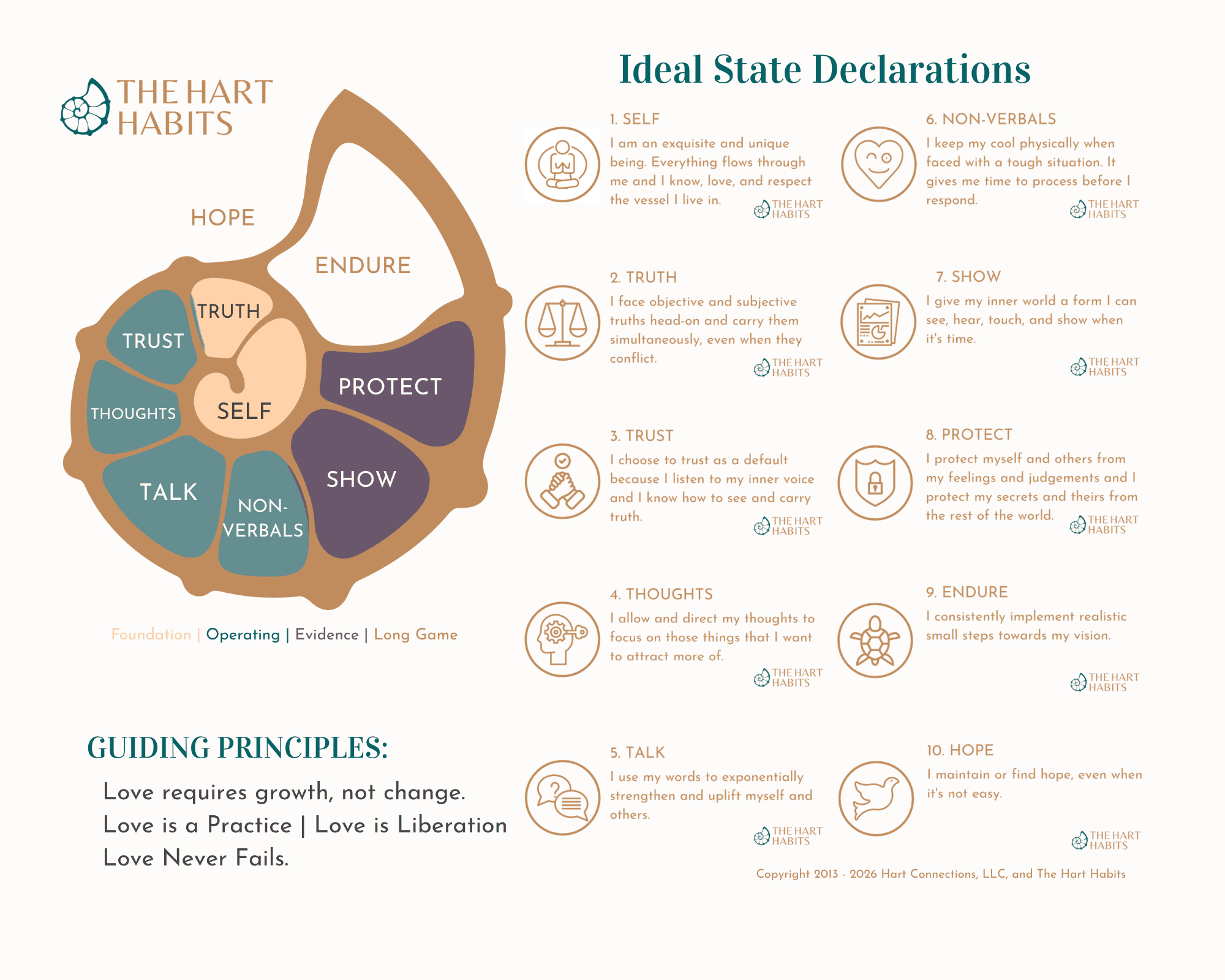
The Hart Habits
I've been developing this framework for the last 15 years. You'll notice a few things about it.
There is a nautilus shell. This is a sea animal, and there's real significance to its shape and to how it's used in this design. You'll also see 10 Habits listed out, each with a mantra of one or two sentences at most. And underneath the shell, you'll find the guiding principles, which explain what the shape means and how the whole thing fits together.
Guiding Principle #1 — Love Requires Growth, Not Change
This refers to the nautilus shell itself, and the animal that grows in this particular shape.
If you've studied trigonometry, geometry, or any of the maths, you know about the Fibonacci spiral. The nautilus shell displays that in a beautiful way. You see this spiral shape throughout nature, a kind of perfect math.
The interesting thing about the nautilus is that as it grows, it doesn't change its shape. It simply gets bigger. That's the same as love.
In our society, we've misinterpreted love, and I was guilty of trying to be someone that another person would want. Unfortunately, that someone kept changing depending on who the other person was, because I was trying to be who they wanted. That meant I wasn't actually myself for any of them. I was lying to all of them, and I was lying to myself.
So the first guiding principle of the Hart Habits, and of love as I've defined it through this framework, is that it requires growth, not change. Love doesn't need you to be anything different than you are. You are perfect exactly as you are right now. Everything about you is perfect right now.
Will you grow over time? Yes. Will you change over time? Probably. But love doesn't require you to change. Love loves you just like you are, in any given moment.
Guiding Principle #2 — Love Is a Practice
These 10 Hart Habits need to be practiced consistently over time. Practiced that way, they become easier and easier to implement, and they all work together to strengthen and reinforce one another. You can't just take the framework one day and, boom, life is a success the next. I've been working on it for 15 years. Hopefully it only takes you a year or two of intentional practice to see some massive changes in your life. But that depends on how intentionally you put them into practice.
Guiding Principles #3 and #4 — Love Is Liberation, Love Never Fails
I started this work because of the saying that love never fails, but it had failed me a lot. I built The Hart Habits on a model of love I understood, but it grew into the one I'm sharing with you today, because my wish, at the very beginning, was to understand this concept of love from a practical standpoint. I wanted to understand how to do it. How do I live love? How do I implement it? Because I had been doing what I thought it was, and I was hopeless and in terrible shape, and I didn't understand why.
That's why love was the foundation of what I've built. I believe love is liberation, and that as we apply these principles to our own lives, our relationships, our decisions, and our families, we can bring liberation for all of us. Thinking and acting this way causes us to do things, in our spheres of influence, that provide liberation, justice, and space for everybody to exist exactly as they are. That's a big dream. But who would I be, doing this work, if I didn't have a big dream?
The Four Layers
The 10 Habits aren't just a list, they're built in four layers, and each one does something different.
Foundation comes first: Self and Truth. Both are work you do with no one else in the room. Self is knowing and respecting your own vessel. Truth is your capacity to hold objective and subjective reality at once. Neither one requires another person to exist or be practiced. They're what you bring to a relationship before there's a relationship to bring anything to.
Operating is next: Trust, Thoughts, Talk, and Non-Verbals. These are the four running in real time, while you're actually with someone. Trust is the stance you bring to them. Thoughts is what's happening internally while you're together. Talk and Non-Verbals are the two channels you're communicating through, word and body. This is the moving machinery of a relationship in motion.
Evidence comes after that: Show and Protect. This is the layer where things become visible and provable. Show is literally about giving your inner world a form others can see, hear, and touch. Protect is the flip side: what you choose to guard, and how you hold what someone else has shown you. Together, these are where trust gets built through consistent, visible follow-through, or breaks because the evidence doesn't match the words.
Long Game comes last: Endure and Hope. These two are different from the other eight in two ways. First, they're not only Habits you practice, they're also what you receive as evidence that the other eight are working. Second, only one of them stays entirely personal. Endure is the discipline of consistent small steps, sustained by you, over time. Hope does that too, but it doesn't stop at the individual. Hope reaches outward, into your relationships, your network, your community, and draws on them as part of how it's built and renewed. That's why Hope sits last: it's both the outcome of everything before it holding together, and the point where the whole practice stops being just about you and starts being about everyone you're in relationship with.
The Ten Hart Habits
I'll walk through the placement of each Habit here, without diving too deeply into any one of them. Each has its own dedicated page where you can go deeper.
The first part to focus on is the model itself, the nautilus shape. You'll notice the very first, central word is Self. Because if you don't know, love, and respect the vessel you walk in, you cannot bring your full potential to anything else in this world. No relationship, no job, no parenting role, nothing. You can't bring your full self if you don't know who your full self is.
Foundation
Habit 1 — Self
I am an exquisite and unique being. Everything flows through me, and I know, love, and respect the vessel I live in.
This is key: everything flows through you. When I talk about truth, I talk about the difference between objective and subjective truth. When we really think about it, almost everything we believe to be true is subjective. It has to come through our brain, our body, and our filter for us to receive it. Understanding and appreciating that is the key to seeing things as objectively as possible. I break Self down into four areas: Strengths, Shadow, Spirit, and Boundaries.
Habit 2 — Truth
I face objective and subjective truths head on and carry them simultaneously, even when they conflict.
Truth is number two for a reason. Everything else has to be based on understanding how to come back to what is true, both objectively and subjectively. Learning to appreciate, celebrate, and take those things into account as you make other decisions in your life makes a world of difference.
Operating
Habit 3 — Trust
I choose to trust as a default because I listen to my inner voice and I know how to see and carry truth.
You'll notice Trust rests on Self and Truth. Simple, but definitely not easy.
Habit 4 — Thoughts
I allow and direct my thoughts to focus on those things that I want to attract more of.
Notice both words: allow and direct. On one hand, thoughts happen in your brain, and we can't be conscious of all of them. On the other, we can be conscious of a lot of them, and we can allow them to come and go, appreciate them, see what they tell us, and let them float away. We can also consciously direct our thoughts toward the things we want to attract more of.
Habit 5 — Talk
I use my words to exponentially strengthen and uplift myself and others.
Once we understand how to evaluate our thoughts, we can use our words to invoke movement in the energy around us. I've talked before about how talk can put things to death, like getting our secrets out in a safe place and putting to death the shame we've been living with. We can also use talk to strengthen and uplift ourselves and others. Our words carry real power, and it's worth knowing how to use them well.
Habit 6 — Non-Verbals
I keep my cool physically when faced with a tough situation. It gives me time to process before I respond.
When we're conscious of our thoughts, intentional with our talk, and aware of what our non-verbals communicate, we can curate a beautiful life. Giving ourselves a moment before responding is where we find our growth, as Viktor Frankl would say.
Evidence
Habit 7 — Show
I give my inner world a form I can see, hear, touch, and show when it's time.
This is a very practical Habit, and it refers to the process of taking things out of our brain and putting them into a form we can see. I talk about using paint, sculpture, writing, a journal, an exercise log, a calendar, or any number of other mediums. The point is to get things out of our body and into a tangible form, so we can create our vision, track our progress, and see and celebrate our success.
Habit 8 — Protect
I protect myself and others from my feelings and judgments, and I protect my secrets and theirs from the rest of the world.
I will never be flippant about how hard this Habit can be to implement. I highly recommend therapy if this is one you struggle with, because you need to get things out, but in a safe environment. I've experienced how hard it can be to get mental health coverage in our system. Don't give up. You're worth getting the help you need, and there are resources available. Look into online programs like betterhelp.com or talkspace.com, or check your local university for learner-staffed therapy programs that sometimes work on a sliding fee scale.
Long Game
Habit 9 — Endure
I consistently implement realistic steps towards my vision.
The key is knowing yourself, staying focused on the goal, and using your strengths strategically to keep moving forward without burning out.
Habit 10 — Hope
I maintain or find hope, even when it's not easy.
Sometimes it really isn't easy. But when you're practicing the other Hart Habits, it gets a little easier, and you know how to tap into your network, your connections, and your community, to find hope for yourself and for the people around you.
Read more about Hope, starting with Part 1 of the Hope series →
Getting Started
This is your introduction to The Hart Habits framework. I hope it's helpful to you.
I'll see you next time. I love you.